 Three Islands GroupLuxury Villa Development · Indonesia
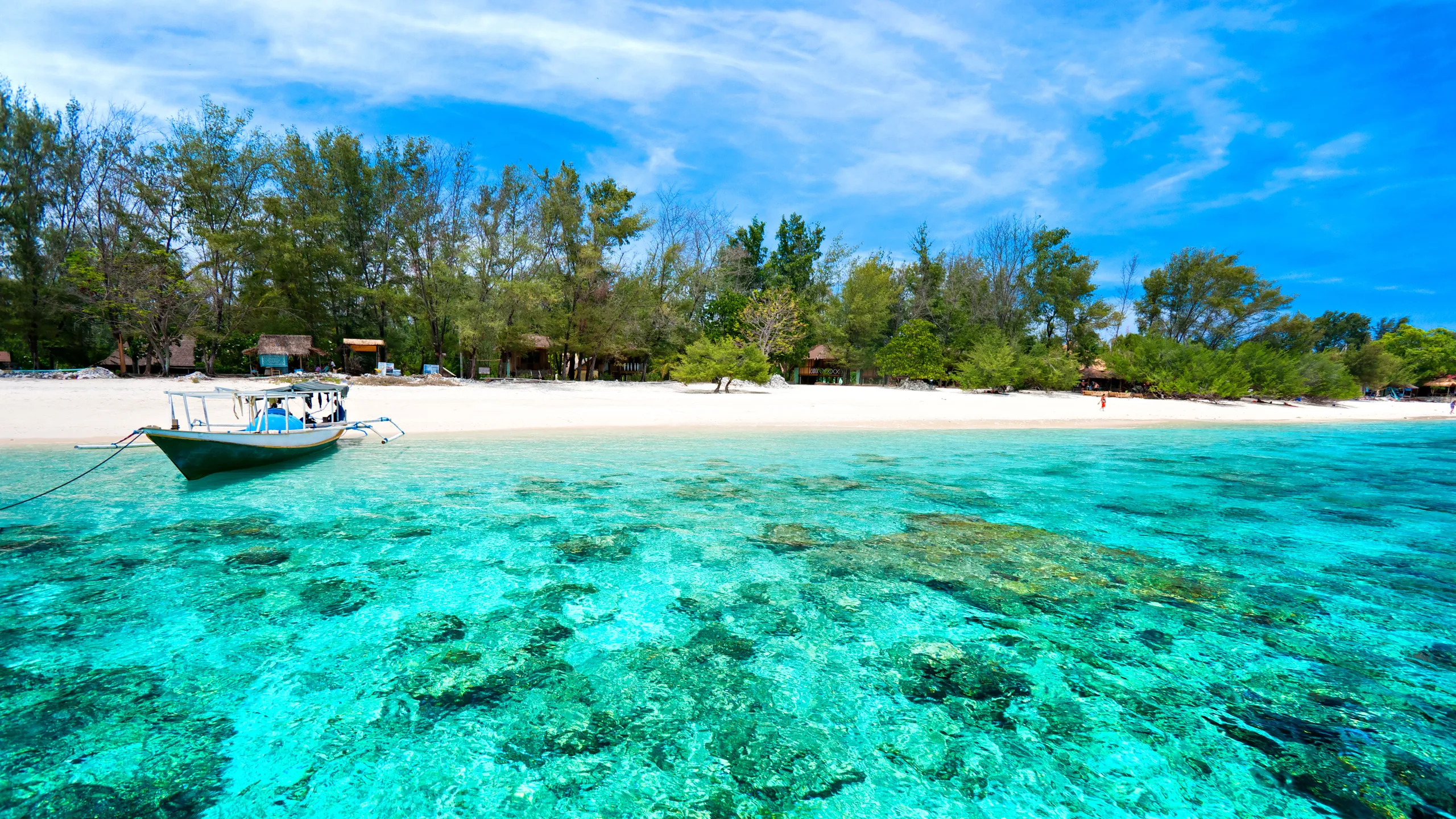
Living Sasak tradition, Majapahit and Balinese roots, a volcanic landscape crowned by Mt Rinjani, and a new residential horizon on the southern coast. The history that gives the place its meaning.
East of Bali, within the province of West Nusa Tenggara, Lombok belongs to the extraordinary string of the Lesser Sunda Islands. More than 4,700 km² of humid forest, savanna, rice fields and Indian Ocean coastline shape a territory where ethnic diversity, scenic richness and a deep cultural tradition all coexist.
It shares with Bali the light, the latitude and a certain tropical charm, but it belongs to a different cultural constellation: here the island ceases to be exclusively Hindu and embraces Islam, mostly through the Sasak people. That transition —geographical, spiritual, scenic— makes Lombok a fascinating threshold.
The doorway where the Indonesia of Java and Bali begins to become the eastern Indonesia.
Whoever lands today at the international airport near Praya does so in a land still close to its essence: roads sinking into rice fields, villages where weaving remains a daily task, and a southern coast whose tourist transformation has not erased its sense of openness, silence and authenticity.
Inhabited since ancient times by the Sasak —communities linked in language and origin to the great Malay archipelago— the island already appears in medieval Javanese sources. From that succession of influences contemporary Lombok has emerged: an island that has managed to preserve its language, its crafts and its landscapes.
The celebrated poem Nagarakṛtāgama, composed by Mpu Prapanca in 1365, places Lombok within the orbit of the Majapahit empire, whose symbolic dominance extended over much of the archipelago.
Spread by figures linked to the Javanese saint Sunan Giri and by the Bugis and Makassarese trade networks, Islam transforms the spiritual life of the island. Alongside orthodox Islam (Waktu Lima) the syncretic Wetu Telu endures, with animist and Hindu elements.
The Balinese kingdom of Karangasem extends its influence over western Lombok, leaving a mark still visible today in Hindu temples, festivals and Balinese communities integrated within the island.
In the late 19th century, Lombok passes under Dutch colonial control, a situation that lasts until the independence of Indonesia, when the island is integrated into the new republic.
Roughly 85% of the island's inhabitants belong to this people, whose language, customs and crafts shape the daily fabric. Sasak culture is not a stage set for visitors: it is an active identity, present in agricultural rituals, ceremonial chants, market life and the patient work of the looms.
Traditional Sasak architecture survives in villages such as Sade and Ende, in the south-central part of the island, where you can still see thatched roofs, floors compacted from a mix of clay and dung, and the celebrated lumbung —rice barns raised on stilts and crowned with curved fibre roofs.
These living villages, far from being folkloric replicas, sustain a way of dwelling deeply tied to the agricultural cycle.
Sade in particular is still an inhabited village: Sasak families living in their traditional houses and keeping hand-loom weaving as an everyday craft. It is a place to visit with respect and a local guide, not an amenity of the project. Source: Indonesia Travel, official tourism portal.
Sasak women weave ikat and songket on hand looms, passing on patterns charged with symbolism from generation to generation. The pottery of Banyumulek and the careful work of local cooperatives —once supported by the Lombok Craft Project— have helped project this heritage beyond the island.
Each piece condenses hours of work, a symbolic geography and a know-how that is learned by sitting next to the one who practices it.
A large drum ensemble that accompanies weddings, circumcision ceremonies and agricultural festivals, the Gendang Beleq is officially recognised as a cultural symbol of the West Nusa Tenggara province.
The sound of these drums —deep, rhythmic, almost bodily— organises the collective memory of the community and marks the great moments of the Sasak calendar.
Each year, on the southern coast, tradition revives in the Bau Nyale festival, dedicated to the ritual catch of the nyale, sea worms that emerge annually from the ocean floor.
Legend tells that princess Mandalika, to avoid choosing among suitors, threw herself into the sea and was transformed into these creatures that return each year to the people who loved her. Her name today gives title to the entire area and represents one of the most beautiful expressions of the local imagination.
Rice articulates the agricultural calendar and sets the pace of the local diet. Three dishes, documented by the State Museum of West Nusa Tenggara, capture the character of the island.
Grilled chicken marinated in an intense blend of spices —garlic, red chili, ginger, palm sugar—. The emblematic dish of Mataram, capital of the province.
Water-spinach salad over a sambal of tomato, chili and lime. Refreshing, fiery and deeply local. It accompanies almost any Sasak table.
Beef skewers marinated in palm sugar and spices, grilled over charcoal. From the Mataram neighbourhood of Rembiga, they are one of the most recognisable flavours of the island.
To the north rises Mt Rinjani, the second-highest peak in Indonesia and one of its great active volcanoes. Its caldera holds Lake Segara Anak, sacred to the Sasak, and since 2018 it has been part of the UNESCO Global Geoparks network.
Gunung Rinjani National Park protects more than 41,000 hectares of tropical forest, savanna and volcanic formations, drawing trekkers from around the world each year. Off the north-west coast, the Gili Islands —Trawangan, Meno and Air— offer crystalline waters and coral reefs.
For years Lombok lived in the shadow of Bali. Today, without losing its character, it is one of the protagonists of Indonesia's new tourist map. The government has included it in the strategic "10 New Balis" programme, aimed at diversifying the country's tourist destinations.
Special Economic Zone inaugurated by President Joko Widodo in 2017, managed by the Indonesia Tourism Development Corporation (ITDC). Around 16 km of coastline on the southern shore of the island.
Pertamina Mandalika International Circuit, 17 corners, inaugurated in 2021. Hosts the Indonesian MotoGP Grand Prix since 2022. The 2025 edition drew close to 140,000 spectators.
Runway at Zainuddin Abdul Madjid International Airport, in Praya. Direct connections to Jakarta, Denpasar, Surabaya, Kuala Lumpur and Singapore. 30 minutes from Kuta Mandalika.
A national policy identifying ten priority destinations —including Mandalika, alongside Lake Toba, Borobudur, Labuan Bajo and Wakatobi— to which investment, infrastructure improvements and international promotion are channelled. Mandalika is, in addition, part of the Super Priority Tourist Destinations programme.
The Indonesian administration has modernised its migration policy with figures such as the Second Home Visa, the Indonesian Golden Visa and the digital nomad visa, in line with what other Southeast Asian countries have done. A clear general orientation toward attracting solvent international residents.
Lombok has decided to write its future without giving up its past.
Where other destinations have transformed at the cost of their identity, Lombok has managed to absorb modernity without dissolving the Sasak soul. These are the qualities that, today, make the south of the island an unusual setting.
A few minutes from the island's only international airport and from the consolidated services of Kuta Mandalika. Are Guling, slightly apart, offers the rare combination of closeness and seclusion.
Open bays, green hills, a coast still largely unspoilt and a wide oceanic horizon. An unusual setting in the Indonesian archipelago for waking up looking at the sea.
Southern Lombok is going through a period of development well documented by the authorities, with significant public and private investment and growing attention from media and tour operators.
A life that blends sea, culture and serenity. Combine personal use as a second home with periods of vacation use or, eventually, with operation as tourist accommodation under professional management.
Lombok, patient and luminous, keeps revealing itself. Aregulin Estates is our way of inviting you to take part in that moment.